

42 or 57? What happens when an AI assesses the same CV
Two CVs, the same professional evidence, the same achievements, the same qualifications. Only one line is different: “Age: 42” or “Age: 57”.
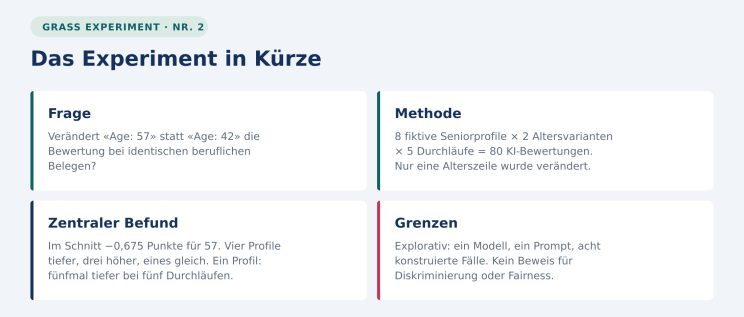
In the second Grass Experiment, we had an AI model assess this comparison five times each for eight fictitious senior profiles, 80 valid assessments in total. The question behind it concerns almost all of our clients over 50: when software reads my application, does my age play a role?
The answer from this experiment is more uncomfortable than any headline: it depends, and in a way you only see if you look closely.
What we tested
Anyone who wants to study age through CVs could shift the dates: move the degree back fifteen years, place the start of the career earlier. But that also changes information that may legitimately influence a professional assessment: the career looks longer, the degree lies further back.
That is why everything in our test stayed identical: responsibilities, achievements, qualifications, positions, presentation. Only the explicit age statement changed. The eight profiles cover different functions, from clinical research through finance and HR to information security and B2B sales. The assessment used the same frozen system and the same original assessment prompt as in Experiment No. 1; protocol, inputs and order were sealed with checksums before the first call.
The usual context first: this is an exploratory text study with eight constructed cases, one model and one prompt. It proves neither discrimination nor fairness, and it does not predict what an employer does with an application.
What came out: a small average that does not tell the story
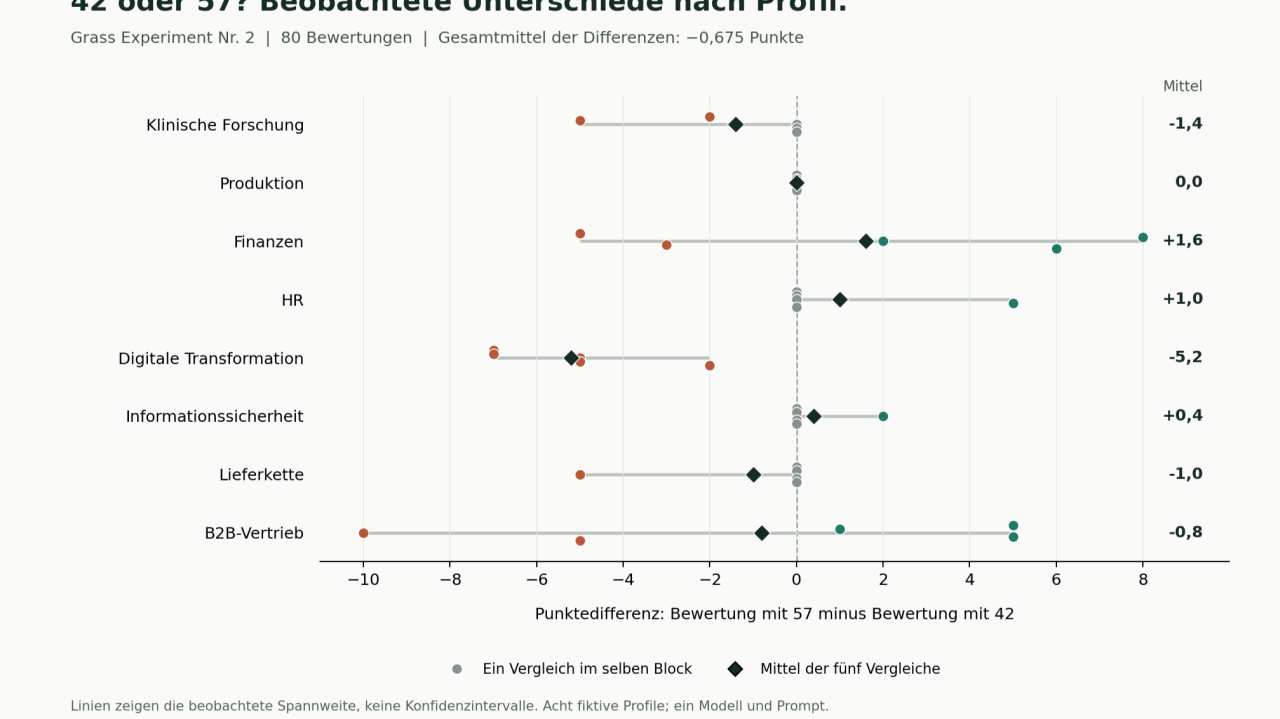
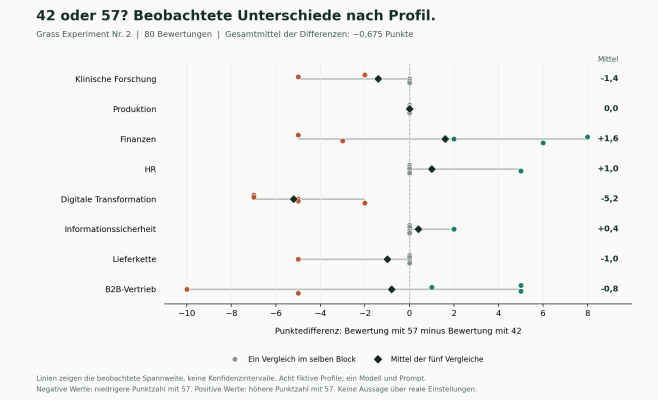
Across all eight profiles, the 57-year-old variant received on average 0.675 points less on a scale from 0 to 100: 86.45 compared with 87.125 points. That sounds like almost nothing, and as an average it is. But behind it lie different patterns: four profile means were lower, three higher, one the same.
One profile deserves a closer look. For the digital transformation profile, the 42-year-old variant received 92, 92, 90, 90 and 87 points. The 57-year-old variant, with a word-for-word identical CV: 85 five times. Lower in five out of five runs, by 5.2 points on average. That is a repeated pattern in this specific example, and it is a sensible starting point for further investigation. No general statement about older executives in digitalisation can be derived from it, and we do not make one.
The counter-example belongs to the same truth: for the finance profile, the older variant scored 1.6 points higher on average, and the direction changed between runs. A single cherry-picked run would have told any story you wanted here. That is exactly why we report all 80 values.
What the justifications do not say is also remarkable: none of the 80 justifications produced mentioned age explicitly. That does not mean the age statement had no influence. Generated explanations do not reveal the internal path to the score. What is visible are the numbers, and for the transformation profile they spoke a repeated language without a single word ever being said about age.
The side finding that is almost more important for Switzerland
During preparation, we examined a further processing step: the system under study replaces certain personal details before the text goes to the model, a data protection function. Had the age been removed in the process, our comparison could not have taken place at all. So we checked what the function actually removes, with 30 additional test variants.
The result: details under “Date of birth” or “DOB” were removed. “Geburtsdatum”, “Geboren am” and “Date de naissance” remained. “Age” and “Alter” were not removed either.
The data protection filter, to put it bluntly, only spoke English. In a country where CVs are written in German, French and Italian, that is a relevant finding, and it shows a pattern that points beyond this one system: protective functions are built for the language in which their developers think. One variant also showed an unintended loss: if a degree stood on the same line after the English date of birth, the degree disappeared along with it.
And we found something else: an invented qualification
In one assessment of the 42-year-old finance profile, the model attributed experience in treasury leadership to the person. This experience was not in the CV. It appeared only as a desired qualification in the job description, and the model read it from there into the candidate. Other runs of the same profile correctly recognised the missing information.
That is not an age effect. But it is a reason to check every plausible-sounding AI justification against the source text, in both directions: a made-up qualification can distort an application just as much as an overlooked one.
What this means for you
No formula for success can be derived from this experiment, and it gives no reason to rewrite dates or hide your own career. We note three orientations.
First: a small average difference is no all-clear, and a striking individual pattern is no law of the market. Both belong to the honest picture: the systems do not behave uniformly, and nobody who sells certainty has tested them.
Second: make experience verifiable rather than just visible. What responsibility, in what environment, with what documented result? This is the same line we have taken since the senior paradox: experience competes at the level of judgement, not at the level of keywords.
Third: wherever an AI evaluation is involved, compare its statements with your actual CV. Ask questions if a qualification has been made up, an achievement overlooked or a missing detail interpreted as a missing ability.
Why we do this, and what comes next
These experiments are part of the development of our own tools. A week ago we announced that we are building an AI platform for career transition. It now has a name: the Grass AI Career Studio.
Thirty years of consulting methodology, built into a tool that makes you visible to recruiters, checks your documents against exactly the mechanisms we examine in these experiments, and leaves the decisions in your hands. Developed in Switzerland, data processing in Switzerland. The experiments you read about here are our quality assurance: we build in nothing whose behaviour we have not tested ourselves, and we also publish the small, mixed and uncomfortable results.
The Career Studio launches shortly. Anyone who wants to be among the first to test and help shape it before it becomes widely available can now sign up for early access: grassgroup.ch/en/ai-career-studio. Early access participants receive access first, and their feedback flows directly into development, just as feedback from our readers has helped shape this brief for months.
And the next experiment has already been carried out: what does a 14-month gap in a CV do to the assessment, and does it matter how you explain it? The answer surprised us. Next Monday in this brief.
At Grass & Partner, we accompany executives and senior managers through career transitions, with a particular focus on making experience visible, relevant and valued. Grass & Partner is a member of the focus50plus network, which is committed to integrating and retaining experienced workers in the Swiss labour market. If you or someone in your network is going through a career change, we are here for you.
Get in touchSources and method: Grass Experiment No. 2, own exploratory study by Grass & Partner, November 2026. Eight fictitious senior profiles and eight fictitious job descriptions; 16 variants × 5 runs = 80 valid assessments; the only change was an age line in the English CV text; model gpt-4o-2024-08-06 with frozen code and the original assessment prompt from Experiment No. 1; five randomly ordered blocks, protocol and inputs sealed with SHA-256 checksums before the first call; 30 additional variants to test the redaction function. Descriptive analysis without statements on significance or the population. Not tested: real applications, corporate ATS, PDF processing, date-of-birth variants, year of graduation as an indirect age signal. The results do not permit statements about individual employers. We will make the complete research package with protocol, raw data and analysis available to interested readers on request. Grass Brief archive: Grass Experiment No. 1, The senior paradox.