

The gap nobody noticed. Until it was explained.
Last week we announced in this space that the result of the third Grass Experiment had surprised us. Here it is.
Almost every client asks us the starting question sooner or later: what do I do about the gap in my CV? Fourteen months between two positions, and the career guides are in rare agreement: never leave it unexplained. Name it, put it in context, ideally fill it with further training or a mandate and label it.
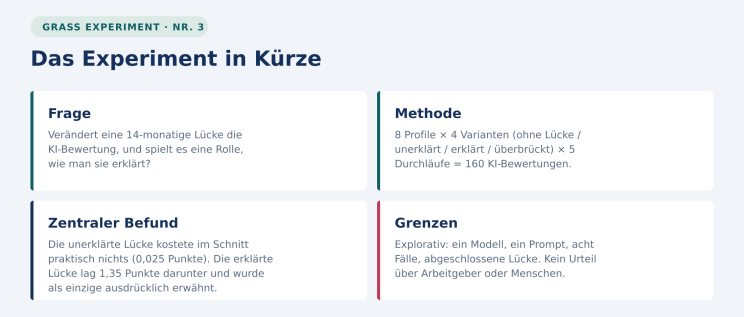
So we tested it. Eight fictitious senior profiles, four variants: without a gap, with an unexplained 14-month gap, with the same gap labelled «Professional reorientation», and with the same gap bridged by an interim mandate or further training. Each variant was rated five times by an AI model, 160 valid ratings.
The result turns the advice-book consensus on its head, at least at the machine level: the unexplained gap cost practically nothing. The explained gap did cost. And it was the only one that ever came up in the model’s justifications.
What we tested
The four variants differ in a controlled way. In variant A, the two most recent positions follow on seamlessly. In variant B, the earlier position ends 14 months sooner; otherwise not a word changes. Compared with B, variant C adds exactly one line: «2023–2024 · Professional reorientation (14 months)». Variant D instead fills the same period with a professionally relevant interim mandate or further training, without any additional claims of success.
Important: in all variants, the current role has been running since November 2024. We examined a closed gap between two jobs, not current unemployment. That is a difference with consequences, and the test of the open, ongoing gap is still to come.
As always, first the honest context. The comparison of A with B does not isolate a pure «gap penalty»: with the earlier end date, 14 months of documented employment are also missing. In C and D, information is added; this is not purely a question of wording. Whether a mandate works better than further training we cannot say, because the two were assigned to different profiles. And as always: one model, one rating brief, eight constructed cases. No proof of discrimination or fairness, no prediction of employers’ decisions.
What came out
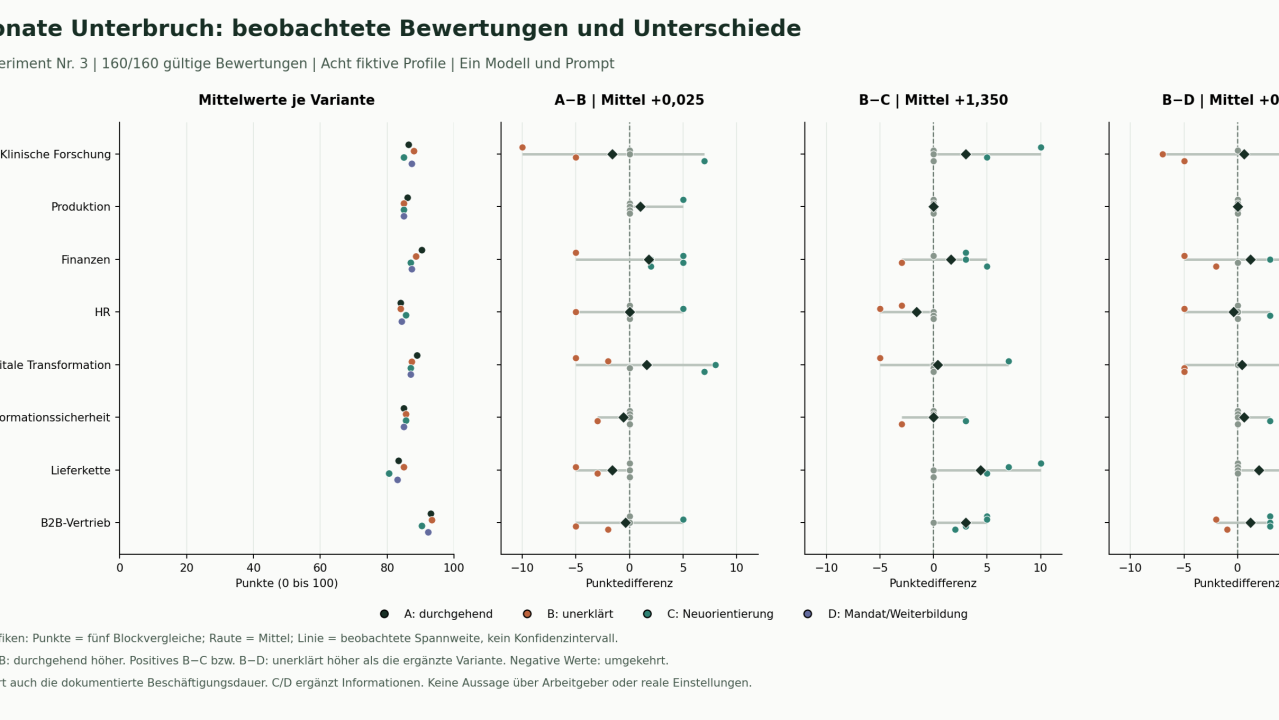
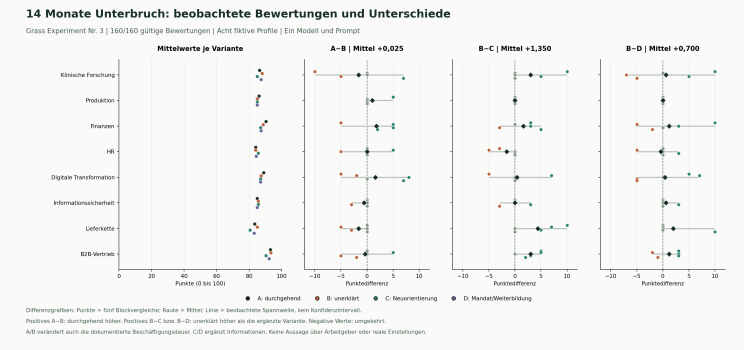
First: the gap itself cost practically nothing on average. The continuous career history received 87.15 points, the history with an unexplained gap 87.125. A difference of 0.025 points, and four of the eight profiles even scored better with the gap. An almost unchanged mean does not prove equal treatment, but the feared automatic penalty for the bare gap did not appear in this experiment.
Second, and this is the surprise: the labelled gap was on average 1.35 points below the unexplained one. In five of eight profiles the «Professional reorientation» scored worse than silence, in two the same, and only in the HR profile better. Most clearly in the supply chain profile: the unexplained variant received 85 points five times. The labelled one: 75, 78, 85, 80, 85. On average 4.4 points less, for the same CV with one additional honest line.
Third: the bridged gap brought no bonus either. Mandate or further training was on average 0.7 points below the unexplained variant. The added activities were not mentioned in a single one of the 40 corresponding justifications.
The mechanism: attention follows the explanation
The most revealing finding lies in the justification texts. We went through all 160.
In the 40 ratings of the unexplained gap, the gap was not mentioned a single time. In the 40 ratings of the labelled gap, by contrast, it came up explicitly three times, once with the remark that the period of reorientation could raise concerns among employers. The gap was exactly the same length in both variants. It only became visible through its explanation.
In other words: it was not the gap that drew the model’s attention. The label did. The tag that was meant to defuse the gap was the only thing that made it an issue.
This fits with a caution we know from the first two experiments: generated justifications do not reveal the internal path to the score. A gap that was not mentioned may still have had an effect, and in one case a mention of concerns went hand in hand with the top score of 95 points. Incidentally, this time too we found an invented qualification: for one profile, the model praised «relevant certifications» that were not in the CV. Checking the AI’s statements against the source text remains a must.
What this means, and what it does not
The tempting conclusion would be: simply keep quiet about gaps. It would be wrong, for three reasons.
First, the finding applies to the machine level of one model with one rating brief. People read differently. Recruiters and line managers do notice unexplained gaps, and in the interview the question reliably comes. Anyone who has no well-ordered answer there loses more than 1.35 points.
Second, the mandate and the further training in variant D were real activities. The fact that this one model did not reward them does not make them worthless: they are true, they can be told, and in the conversation they are often the difference between an awkward pause and a confident chapter.
Third, our experiment describes a closed gap followed by a stable current role. The situation of many readers of this brief, in the middle of a transition, with an open present, we deliberately did not test.
What remains is a more precise orientation: the gap in the document is smaller than fear makes it, and the explanation does not necessarily belong where it creates attention, but where it creates trust, in the conversation, in the narrative, in the answer to the question that will come. A document does not have to justify a gap. A person should be able to tell its story.
How this story succeeds, the vocabulary of transition, why «jobseeker» is not the only word, and what decision-makers actually read into endings, is the topic of the next Grass Brief: «How to tell an ending».
A word about ourselves: the experiments and the Career Studio
Three experiments in six weeks, all with a sealed protocol, all published in full, including the small and mixed findings. Why we do this, we said last week: we are building the Grass AI Career Studio, an AI platform for career transition, out of thirty years of Swiss consulting practice. These experiments are our quality assurance. What we build in, we have tested ourselves beforehand, and what we find out, you read here first.
The Career Studio launches shortly: developed in Switzerland, data processing in Switzerland, for every career stage. Anyone who wants to test it and help shape it before it becomes widely available can now register for Early Access: grassgroup.ch/en/ai-career-studio. Early Access participants get access first, and their feedback flows directly into development.
At Grass & Partner, we accompany executives and senior managers through career transitions, with a particular focus on making experience visible, relevant and valued. Grass & Partner is a member of the focus50plus network, which is committed to integrating and retaining experienced workers in the Swiss labour market. If you or someone in your network is going through a career change, we are here for you.
Get in touchSources and method: Grass Experiment No. 3, Grass & Partner’s own exploratory study, November 2026. Eight fictitious senior profiles in four variants (continuous / unexplained gap / labelled gap / bridged gap), 32 conditions × 5 runs = 160 valid ratings; gap period September 2023 to October 2024, current role from November 2024; model gpt-4o-2024-08-06 with frozen code and the original rating brief from experiments No. 1 and 2; protocol, inputs and order sealed with SHA-256 checksums before the first call; all 160 justifications reviewed (AI-assisted, without independent human second coding). Descriptive analysis without statements on significance or the population; 103 of the 160 ratings were at exactly 85 points. Not tested: current or open gaps, other gap lengths, real applications, company ATS, human recruiters, German model inputs, isolated comparison of mandate versus further training. The results do not permit any statements about individual employers. We will make the complete research package with protocol, raw data and analysis available to interested readers on request. Grass Brief archive: Grass Experiment No. 1, Grass Experiment No. 2, 7.3 months.