


DE|EN|FR|IT

Grass & Partner

Last week we asked whether the market is turning: vacancies are rising again and hiring intentions are brightening. The obvious reaction of many jobseekers is to start writing more applications again. Before you do, it is worth looking at a figure that shows where this recovery becomes visible at all, and where it does not.
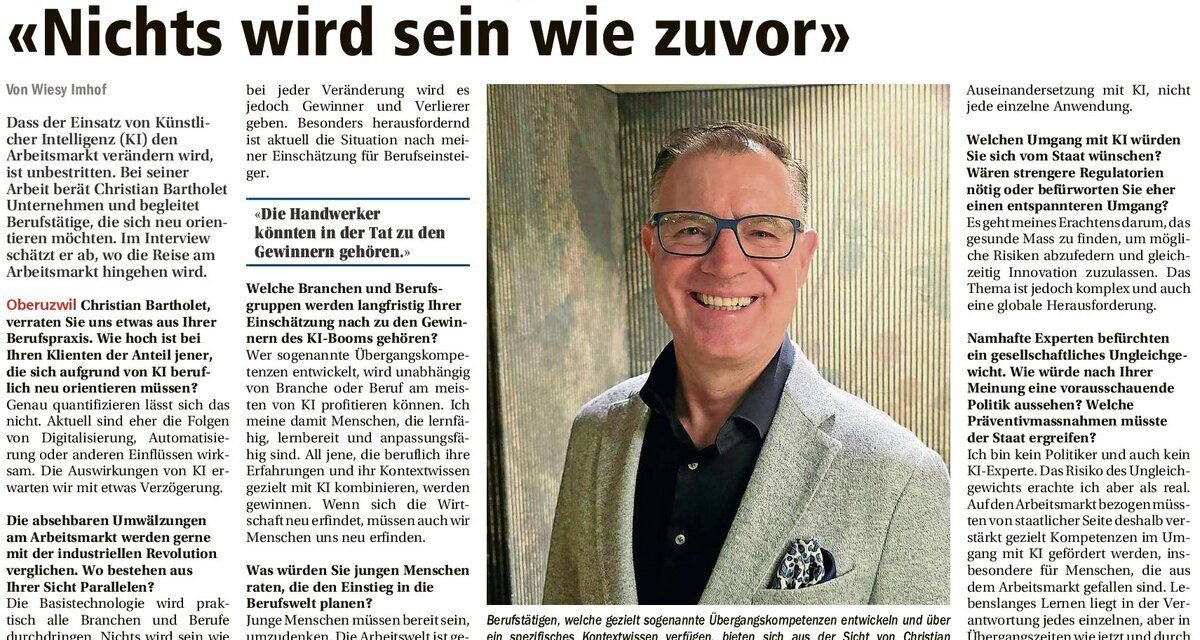

What does artificial intelligence mean for the labour market – and for each individual? The Wiler Nachrichten put the question to our CEO Christian Bartholet on 24 September 2026. His assessment is already in the headline: nothing will be as it was before.

For more than a year, this brief has told a consistent story about the Swiss labour market: record employment, but a narrowing visible market. Vacancies down from 123'000 to 86'000. Applications per job ad up by as much as 50 per cent. Companies cautious, processes slow, jobseekers above 230'000.

Imagine a head of division whose annual reviews have gone exceptionally well for three years. The results are right. Her team delivers. When difficult projects come up, her name is mentioned first. The next career step is also discussed. Only there is never a date for it.

An executive who is reorienting professionally usually begins the search with familiar categories. Industry. Function. Company size. Area of responsibility. The next role should match their experience and allow a meaningful step forward.

September begins next week. The out-of-office replies disappear, paused processes restart, headhunters return with mandates. Many executives in transition have used the summer to sharpen their positioning and define their target companies.

There is a dimension of career transition that has no module of its own in any outplacement programme, that is hardly ever named openly in a consultation, and that nevertheless surfaces at some point in almost every one of our coaching mandates. Usually in passing, in a subordinate clause, after a few weeks of trust.

Anyone who follows the coverage of AI and the labour market experiences a peculiar kind of whiplash. One week a headline announces that AI is eliminating knowledge work on a large scale. The next, another study finds no measurable effect at all. Then a third explains that the whole story was misread from the start.

There is a conversation we have in almost every coaching mandate, usually somewhere between month three and month five. The client sits down, visibly heavier than in the early sessions, and says a version of the same sentence: "I thought I'd have something by now."

Somewhere in almost every senior CV, there it is. The position that ended after twelve, eighteen or twenty-four months. A restructuring that came sooner than anyone expected. A new owner with a different plan. A culture that looked right in the interviews and felt wrong from month three. A mandate that turned out to be something other than what had been described.

Need support?Contact us